Products

.svg)
Accessibility Widget
Accessibility tools for everyone
Accessibility Widget
Accessibility tools for everyone
Accessibility Widget
Accessibility tools for everyone
Accessibility Widget
Accessibility tools for everyone
Last month I was in Ho Chi Minh City for Directions Asia 2026. Five hundred people from the global Business Central community in one room.
I have been to a few technology conferences in the last 20 plus years in my career. Most confirm what you already know, just with great looking slides.
This one was different. I came back with a rethought delivery model and a clear view that the ERP market is moving faster than most businesses realise.
The conversation in that room was not about features or roadmaps. It was about a fundamental shift in what ERP is actually for.

Adam Fudeh, Founder and Managing Director of Storata, at the Microsoft Directions Asia 2026 Conference, May 2026, Vietnam, Ho Chi Minh City
"AI is not an add-on to Business Central. It is fundamentally reshaping how ERP is delivered, implemented, and experienced."
The theme that ran through every session was the shift from systems of record to systems of action.
Traditional ERP captures what happened. People extract that data, make a decision, then go back and record it. The human is the middleware. That model is ending.
Business Central, combined with Copilot and AI agents, is becoming a system that acts — not just one that records. The difference is not incremental. It is architectural. And for businesses that understand it early, the competitive advantage is significant.
BEFORE
Every process touches a human. Data enters the system when a person puts it there. Decisions happen when a person makes them. The bottleneck is always the same — the human in the middle.
THE SHIFT
Agents ingest, validate, process, and act. Humans review, approve, and override. The bottleneck moves from execution to judgment — which is where human expertise actually belongs.
AFTER
Your team stops doing the routine work that a system can do and starts doing the work that only a person with context, judgment, and accountability can do. That is not a threat. That is a liberation.
I want to share some concrete examples because I think abstract when it comes to AI agents, and this loses people. The demonstrations I saw at Directions were not theoretical. They were running. They were fast. And they were extraordinarily capable.
Reads an incoming email. Extracts the order details. Validates the customer. Checks stock availability. Generates a draft quote. All without a human touching it. The salesperson reviews and approves. The processing time that used to be measured in hours is now measured in seconds.
Takes an uploaded invoice. Runs OCR. Maps every line to the correct G/L account. Creates a draft purchase invoice with the right coding. Flags anything anomalous for human review. The accounts payable team stops doing data entry and starts doing accounts payable.
Audits expense submissions in real time against policy. Flags exceptions. Enforces governance before a claim is approved rather than discovering a problem in a quarterly audit. Compliance embedded in the process, not bolted on after the fact.
Human in the loop — always. The agent executes. The person approves. The judgment stays with the human. The processing moves to the machine. That balance is not accidental. It is by design. And it is exactly the governance model Storata has been advocating for.
I will be up front: this event did change how I think about Storata's consulting model.
The constraint in delivery has always been capacity — how many consultants do we have, how many hours do they have, how many projects can run simultaneously. What I came home understanding is that AI is compressing the consulting lifecycle in ways that change this equation fundamentally.
Discovery that would take three weeks of workshops can now be synthesised faster with AI-assisted requirements analysis. Solution design that relied on a senior consultant's pattern recognition can be accelerated with AI-assisted solution mapping. Development that required a developer to write every line can be augmented with Copilot-driven AL development. Testing that was manual and time-consuming can be automated with evaluation harnesses.
The result is faster delivery cycles, lower cost of change, and — critically — higher client expectations of output quality. Because when AI removes the friction from delivery, clients rightly ask why things take as long as they used to.
"The constraint is no longer development capacity. It is the time from signal to action."
What this creates is a newly emerged fresh minded Storata. I have been calling it Consultant 2.0 in my own thinking. Someone who combines deep industry and domain expertise with strong AI capability — who can prompt effectively, validate AI outputs critically, and bring the contextual judgment that no model can replicate. That is the intersection Storata is deliberately building toward.
For those of you who want the technical picture, here is what the agentic ERP ecosystem looks like as it is emerging.
Copilot and AI agents — the way users and automated processes interact with the system. Natural language in. Structured action out.
Business Central, Dataverse, and Microsoft Fabric — the governed, integrated data estate that agents operate on. No governed data, no trustworthy agents.
Model Context Protocol (MCP) — the emerging standard for connecting AI agents across different systems. This is the plumbing that lets an agent in Business Central talk to a system in Dynamics or Power Platform.
Power Platform — the layer that coordinates agents, automates workflows, and connects business processes across the Microsoft ecosystem.
Where this is heading is composable, headless ERP — where Business Central is no longer the monolithic system that everything runs through, but the intelligent data engine that sits underneath a layer of AI-driven interfaces and agents. Prompt-driven development and automation. AI-native integration. This is a genuinely different architectural paradigm and the partners who understand it early will be the ones building the solutions that matter.
Business Central, combined with Copilot and AI agents, is becoming a system that acts — not just one that records. The difference is not incremental. It is architectural. And for businesses that understand it early, the competitive advantage is significant.
The Business Central community is unusually open. Peers who compete for the same clients share knowledge without the usual defensiveness. Microsoft product leaders engaged with hard questions directly. ISVs showed real capability without the usual layers of marketing.
The mix of experienced practitioners and people entering the ecosystem brings a sharpness to the conversation that most industry events lack. The BC community is not just responding to where AI is taking ERP. It is leading it.
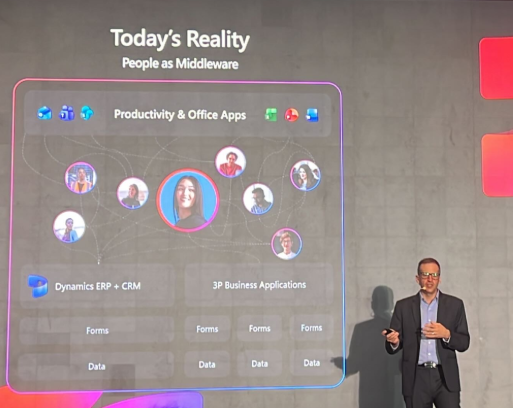
Directions Asia 2026 — the Business Central community in conversation. Mike Morton, Vice President, Dynamics 365 at Microsoft.
The direction coming out of Directions maps directly to where Storata has been building. AI-driven delivery, intelligent automation, integrated data platforms, governance built in from the start. That is not a pivot for us — it is a confirmation.
The direction the market is heading — AI-driven delivery, intelligent automation, integrated data platforms, business process transformation rather than system implementation — is exactly where we have been investing. That alignment is not accidental. It is the result of deliberate choices about where to build expertise and what to say no to.
For Storata clients, the opportunity is significant. If you are on Business Central today, the path to AI-enabled workflows does not require a re-platform. It requires the right architecture, the right governance model, and a partner who understands both. If you are not yet on Business Central but are on a system that is holding your business back, the case for moving has never been stronger.
The era of ERP as a system of record is ending. The era of ERP as a system of action is here. The organisations that make that transition well — with governance built in from the start, not bolted on after the fact — will operate in a fundamentally different way from those that do not.
AI is no longer optional in ERP. It is foundational. The question is not whether your business will operate with AI-driven processes. It is whether you will design them deliberately or inherit them by accident.
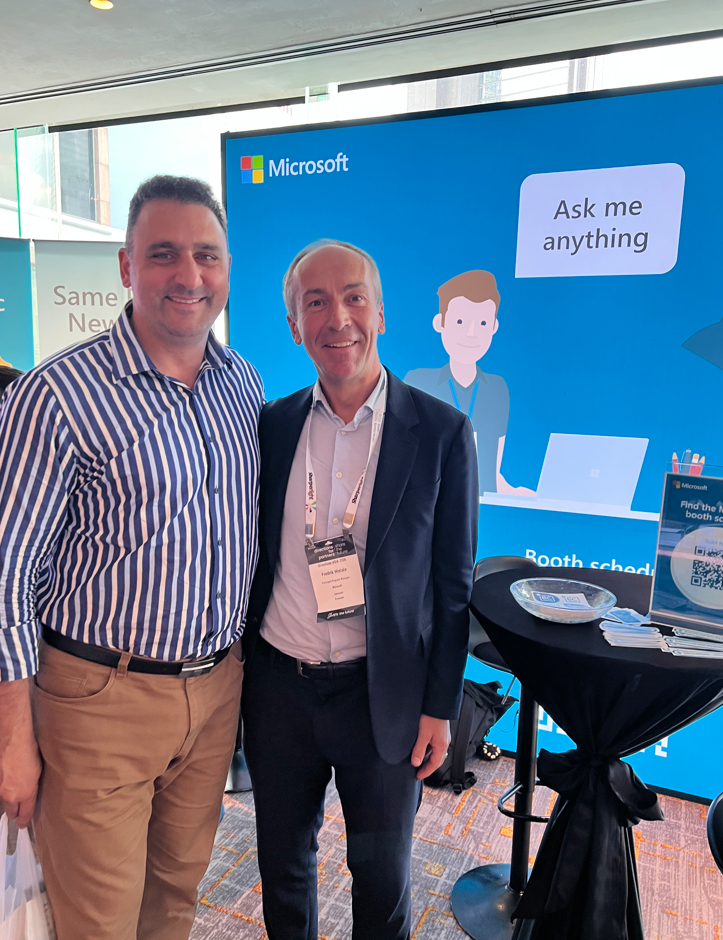
Directions Asia 2026 — Adam Fudeh, Managing Director, Storata with Fredrik Hietala, Microsoft Program Prospect Manager.
To the organisers, sponsors, and Microsoft team who put Directions Asia together — thank you. Events like this are only as good as the thought and effort behind them, and this one was exceptional.
And to the community that showed up and shared openly — this is why the Business Central ecosystem continues to lead worldwide. Not because of the technology alone. Because of the people.
If you want to talk through what this means for your business specifically — whether you are on Business Central today or evaluating your options — that is a conversation worth having.
Adam Fudeh
Founder & Managing Director, Storata
afudeh@storata.com · storata.com.au
Directions Asia 2026 — the Business Central community in conversation. Mike Morton, Vice President, Dynamics 365 at Microsoft.
IN CONVERSATION
Kris Manche
Founder, DIY-ERP · Business Central Specialist · Directions Asia 2026
Kris Manche founded DIY-ERP on a principle that is gaining renewed relevance in the age of AI — that a business which truly understands its own ERP implementation is a business that can grow, adapt, and make informed decisions about what to automate and what to keep human.
I sat down with Kris at Directions Asia to get his read on what Microsoft showed, where the gaps are, and what it means for the businesses he works with.
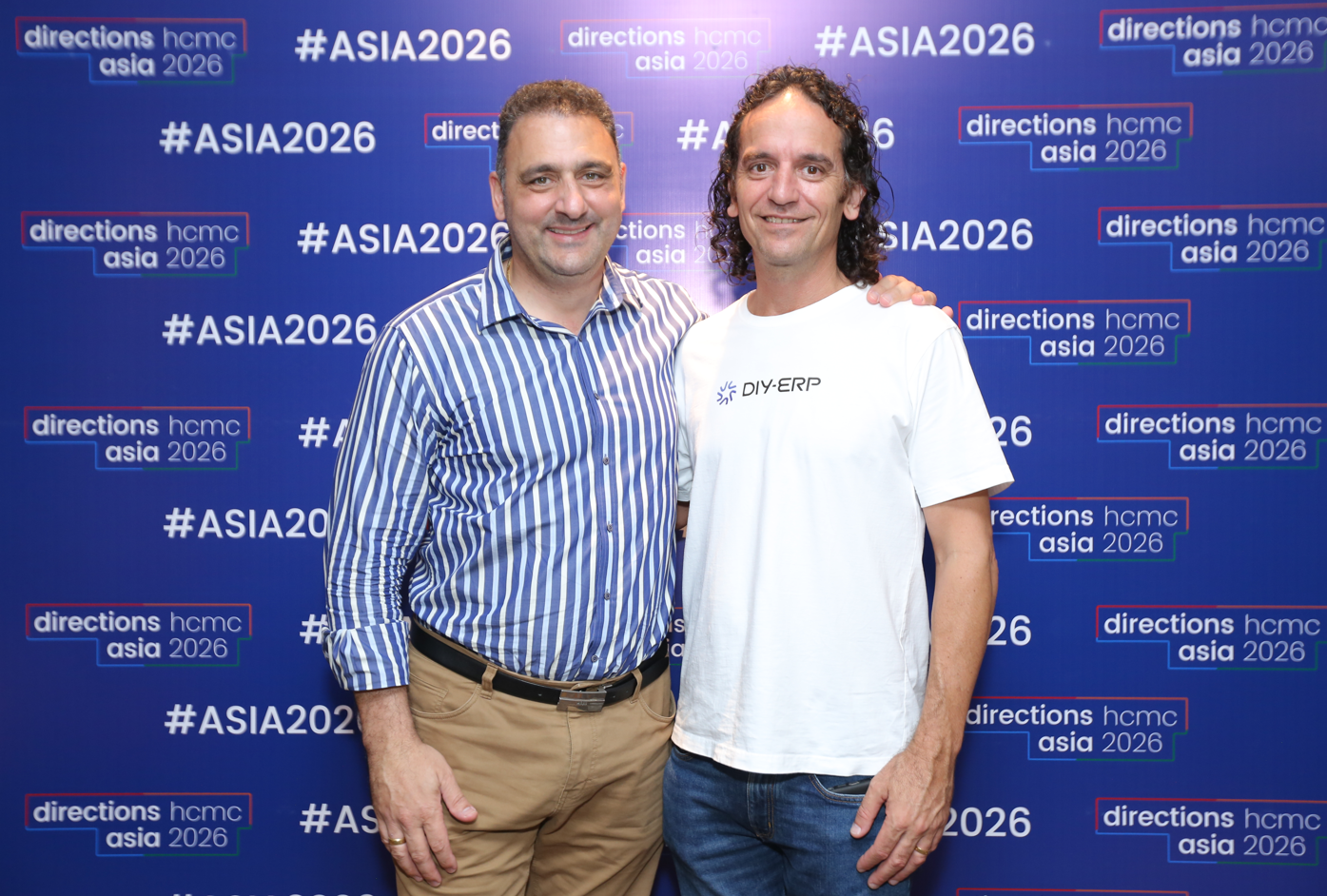
DIY-ERP CEO, Kris Manche with Adam Fudeh, Managing Director Storata, Vietnam, 2026
The market is ready to prepare — but it is not ready to hand over the wheel. What Microsoft showed at Directions Asia was genuinely impressive: live demos of the payables agent, the sales order agent, and a new expense agent, all operating autonomously inside Business Central. But the businesses that have not transformed to ERP with AI built in struggle every day with data quality issues, undocumented processes, and approval workflows that live in someone's head. If you turn an agent loose on that, you do not get efficiency — you get bad decisions at machine speed. My bigger concern is that agentic ERP, applied too early, will create lazy thinkers. ERP implementation done well forces a business to confront how it actually operates, and that thinking is where the value lives. Skip it and outsource the implementation, and you end up with a system that runs fast but nobody truly understands. The honest answer: standardise your processes, get your data clean, get your workflows documented, get your people trained — then you will be in a position to let agents handle the routine work while your team focuses on the decisions that actually matter.
The gap is significant, and it is not a technology problem — it is a people problem. Mike Morton's keynote framed ERP as shifting from a system of record to a system of action, where agents take on the middleware role humans have played for decades. That is the vision. But most partners are still struggling to staff traditional implementations, let alone deploy and govern AI agents on top of them. Microsoft themselves have acknowledged this by launching a Reskill program to bring people in from outside the traditional BC ecosystem, because there simply are not enough experienced consultants to go around. The technology is no longer the hard part — delivery is. The partners who will thrive are the ones who solve the delivery model first, who can get a customer live on Business Central reliably and repeatably, before they try to build on agentic capabilities. The partners who chase the AI headline without a solid implementation methodology underneath it are going to create a new wave of failed projects faster than ever before.
The biggest risk is invisible automation on top of unfinished foundations, without humans in the loop. An AI agent that processes purchase invoices is brilliant — if your chart of accounts is clean, your vendor master data is accurate, and your approval matrix is properly configured. If those foundations are not solid, the agent just automates the mess faster than a human ever could — and worse, makes it harder to fix because you have to understand the problem before you can correct it. The second risk is accountability. When a person makes a posting error, you can trace it, understand why, and fix the process. When an agent does it, the tendency is to shrug and say "the AI did it." Businesses need to treat agent actions exactly like they would treat a new junior employee — supervised, audited, and gradually given more autonomy as trust is earned. The third risk is skipping the learning curve. Peter Borring's session at Directions made it clear that developers and consultants are transitioning into orchestration, validation, and governance roles — the same shift needs to happen at the business level. If AI handles too much too early, you end up with a business that is dependent on technology it does not understand. That is a fragile position to be in.
Three things. First, treat your data like the asset it is about to become. Agentic AI is only as good as the data it works with and the workflows supporting it — so invest now in cleaning up your master data, standardising your processes, and documenting the business rules that currently live in people's heads. Second, start thinking about your team's role differently. AI agents are going to handle more of the transactional work inside Business Central — matching, posting, classifying — which means your people need to shift toward exception management, analysis, and decision-making. That is a mindset shift, not just a technology upgrade. Third, do not wait for your partner to bring this to you. Mike Morton closed the Directions keynote by telling partners to drive AI transformation in their own businesses first, before taking it to customers. The same applies to business owners: the ones who get the most value from what is coming are the ones who own their system, understand how it works, and can make informed decisions about what to automate and what to keep human. That has always been the DIY-ERP philosophy — and it has never been more relevant than it is right now.
It was Mike Morton's keynote. He framed Business Central's future as a shift from a system of record to a system of action — where agents take on the middleware role that humans have played for forty years, and humans move up to direct, govern, and review what the agents produce. That landed hard, because it is exactly the principle DIY-ERP has always been built on: the human needs to understand the system, not just use it. What changed for us is the urgency. Microsoft is clearly building toward a Business Central where agents handle the routine and humans handle the judgment. That means the implementation phase — where the client learns how the system works, why it is configured the way it is, and how to make decisions with it — becomes even more critical, not less. If you skip that phase and go straight to agents, or outsource the configuration, you have got automation without comprehension. DIY-ERP has always been about making sure the business owns its implementation, and what I saw at Directions Asia confirmed that this approach is not just still relevant — it is essential.
Kris Manche
Founder and CEO, DIY-ERP · diryerp.com.au